Description
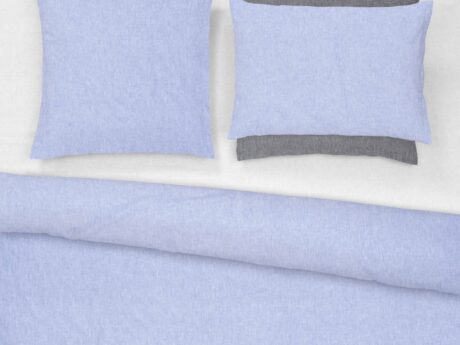
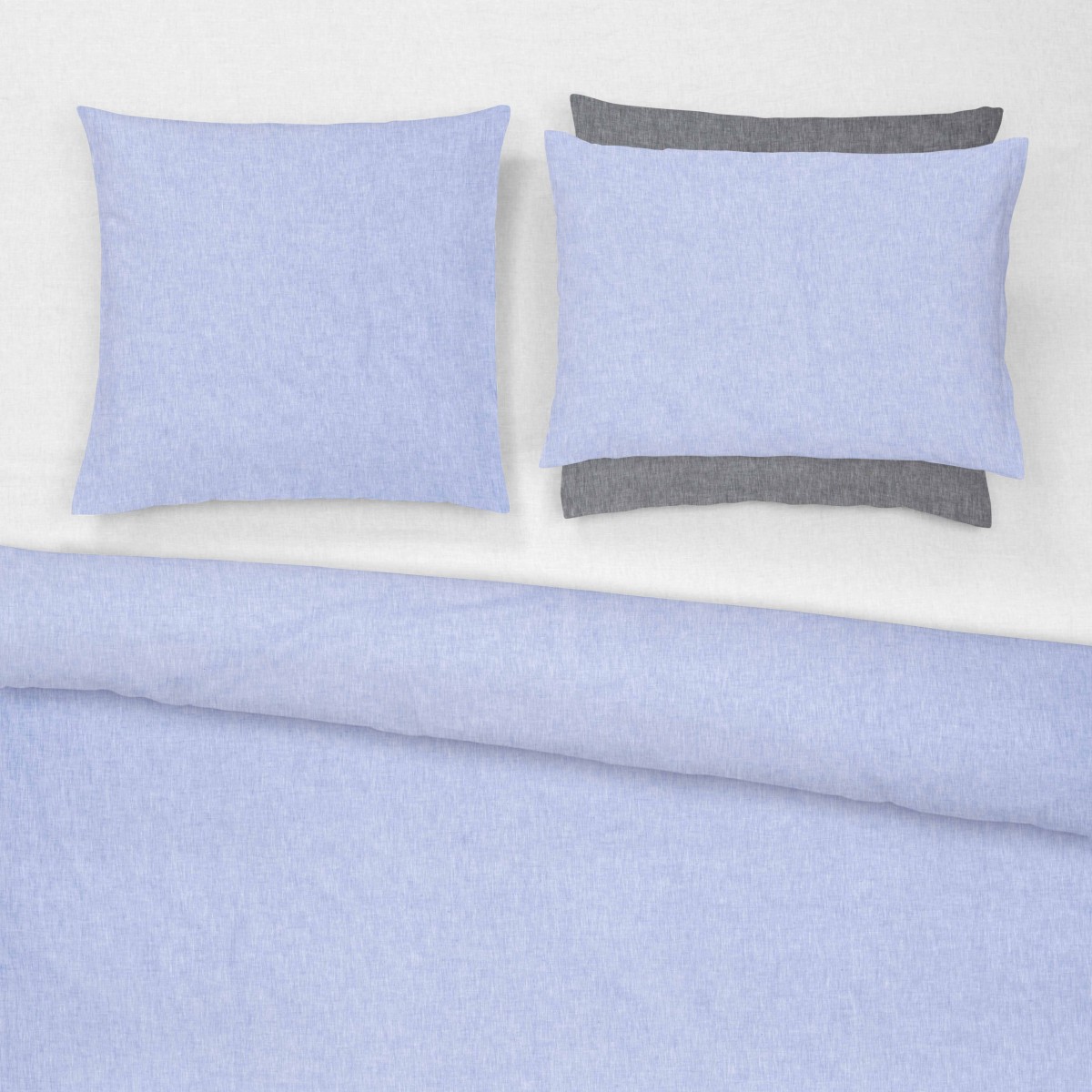
The Christian Fischbacher Moments – Sunkiss bed linen set brings the effortless ease of summer into your bedroom. Part of the Moments collection — its soft dusty blue tone evokes clear skies and warm, sun-drenched mornings.
Made from a 50% cotton / 50% linen blend, the Crispy Linen fabric has a characteristically fresh, slightly textured feel that is perfect for warm seasons. The natural linen component keeps you cool and comfortable through warm nights, while the cotton adds softness and makes the fabric easy to care for.
Set includes:
- Duvet cover: 155 x 220 or 200 × 220 cm
- 2 Pillowcases: 50 × 70 cm
Product details:
- Composition: 50% Cotton / 50% Linen (Crispy Linen)
- Color: Dusty Blue (056)
- Closure: Zip
- Wash temperature: up to 60°C
- Certification: OEKO-TEX Standard 100
- Collection: Moments — Timeless · Essential · Contemporary
- Brand: Christian Fischbacher, St. Gallen, Switzerland — Est. 1819
FAQ
What does a 50/50 cotton-linen blend actually feel like, and why is it called “Crispy Linen”?
Pure linen is one of the most breathable natural fibres available, but in its raw state it can feel stiff and rough — particularly in the first months of use. Pure cotton is softer but lacks linen’s natural temperature-regulating properties and distinctive texture. The 50/50 blend in the Sunkiss set is engineered to capture the best of both: the cotton component softens the handle and reduces initial stiffness, while the linen contributes its characteristic cool, slightly textured surface and exceptional moisture-wicking performance. “Crispy” describes the linen-forward texture accurately — this is not a smooth satin or a plush jersey. It has a clean, slightly structured feel that many sleepers find more refreshing than softer alternatives, especially in warmer months. Like pure linen, it also softens progressively with each wash while retaining its characteristic character.
What is OEKO-TEX certification and why does it matter for bed linen specifically?
OEKO-TEX Standard 100 is an independent certification that verifies every component of a textile — fabric, thread, dyes, and finishing agents — has been tested for harmful substances and meets strict safety thresholds. For bed linen this is more relevant than for most other textiles: you spend roughly a third of your life in direct skin contact with your bedding, and the chemicals used in dyeing, bleaching, and finishing conventional fabrics can include formaldehyde-based wrinkle treatments, azo dyes, and residual pesticides from non-certified cotton. OEKO-TEX certification means none of these are present above safe limits. It is one of the few genuinely meaningful quality signals in the textile industry — independently audited, not self-declared.
Is dusty blue a colour that holds up well in a linen-cotton blend over repeated washing?
Linen fibres hold dye differently from cotton — the natural variation in linen’s fibre surface creates a subtly uneven dye absorption that gives piece-dyed linen-blend fabrics a soft, lived-in depth of colour even when new. In dusty blue, this characteristic is a design feature rather than a limitation: the slightly heathered appearance gives the set a relaxed, artisanal quality that solid-dyed pure cotton cannot replicate. Over time, linen-cotton blends do soften in colour tone with washing — which for a dusty, muted blue tends to make it more beautiful rather than less, developing the faded, sun-bleached quality the “Sunkiss” name deliberately evokes.
Why does a cotton-linen blend set cost more than a comparable pure cotton set?
Linen fibre — spun from flax — is more costly to produce than cotton at every stage: flax cultivation is more labour-intensive, the fibre extraction process (retting and scutching) is more complex, and linen yarn is more demanding to weave consistently than cotton. A quality 50/50 blend therefore carries a higher raw material cost than an equivalent pure cotton construction, and the weaving requires more precise tension control to handle two fibres with different elasticity properties in the same structure. Christian Fischbacher’s Swiss manufacturing adds a further layer of quality control — the OEKO-TEX certification is not automatic but requires ongoing testing and compliance costs that are built into the product price. At Sleep Gallery you can feel the Sunkiss set alongside the brand’s pure cotton percale and satin options to understand exactly where the textural and material differences lie before deciding.